
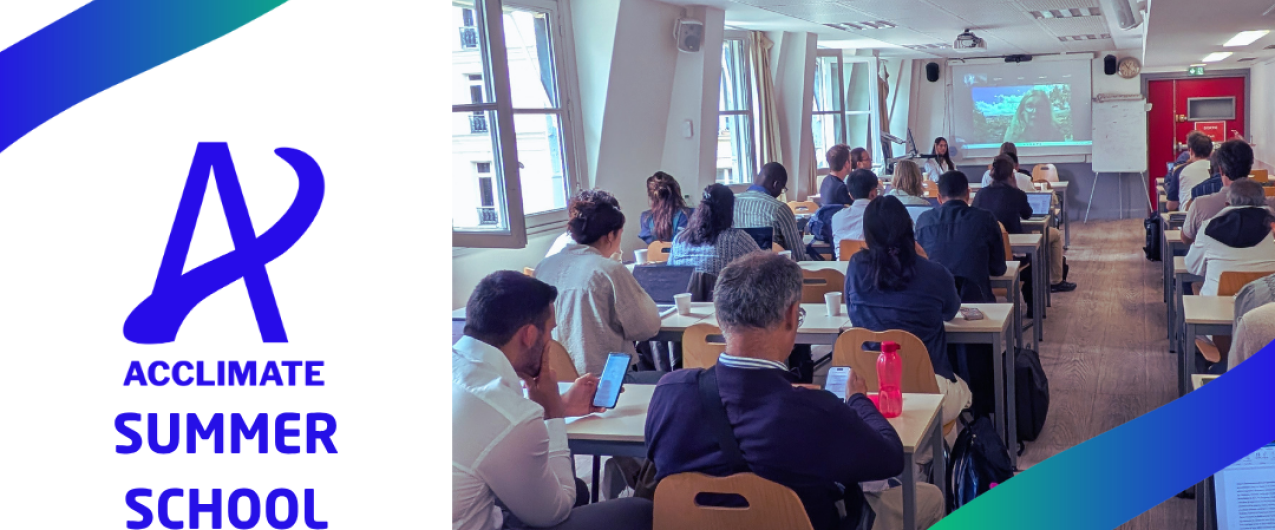
Summer School Focuses on Climate Pathways and Modelling
On 3 and 4 June 2026, ACCLIMATE's country partners gathered in Paris for a two-day Summer School on climate pathways and modelling, co-hosted and led by IDDRI. The event brought together national teams and partners from across the consortium for a series of interactive training sessions aimed at strengthening the modelling capacity of partner countries, so that national teams can design and analyse emission-reduction pathways that are both scientifically robust and genuinely useful for policymakers. Sessions combined methodological discussion with hands-on exercises, giving participants a shared space to build skills together, exchange views on the strengths and limits of the modelling approaches used in the project, and get practical experience with new tools, including geospatial approaches to assessing energy access, electrification and clean cooking, which are especially relevant for many of the developing countries in the consortium.
The Summer School was completed with great success, over two full days of discussion and training.
Inside the Programme
Day 1 opened with an introduction to the objectives of the Summer School, followed by a session on framing, designing and reporting policy-relevant pathways at the national level, led by IDDRI. Participants split into breakout groups to work through practical exercises based on the Indian and Senegalese scenarios. The day continued with a session on integrating a gender-specific approach into climate policy modelling, led by Wuppertal Institute, which combined reflection, discussion and practical exercises on building gender-sensitive narratives for national pathways, including in contexts where disaggregated gender data is limited.
Day 2 began with a session on how to represent systemic and long-term transformations in modelling, jointly led by IDDRI and KTH. Long-term structural shifts, such as those needed in the freight sector, are notoriously difficult for models to capture, and participants worked in breakout groups to map key transformations in their own countries and discuss how to communicate the limits of modelling assumptions in national policy debates. This was followed by a hands-on session introducing the Pathway Designer, a quantification tool developed by the Deep Decarbonization Pathways (DDP) initiative for policy-relevant analysis of low-carbon transitions, with exercises focused on the passenger transport and AFOLU (agriculture, forestry and land use) sectors. The programme closed with an introductory, hands-on session led by KTH on geospatial energy access modelling, giving participants practical experience with open-access tools used for electrification planning.
Looking Ahead: Advancing the Modelling Work
The skills and tools shared during the Summer School will directly feed into the next phase of ACCLIMATE's work on finalising the national pathways for each partner country. These pathways aim to inform the next generation of national climate strategies, including updated NDCs and long-term strategies, and to feed into international processes such as the UNFCCC's Global Stocktake and the IPCC's next assessment report.
A first cross-country comparison of these pathways is planned for early 2027, bringing partner countries together to discuss what these results mean for national and international climate policy.